How a healthy hip works
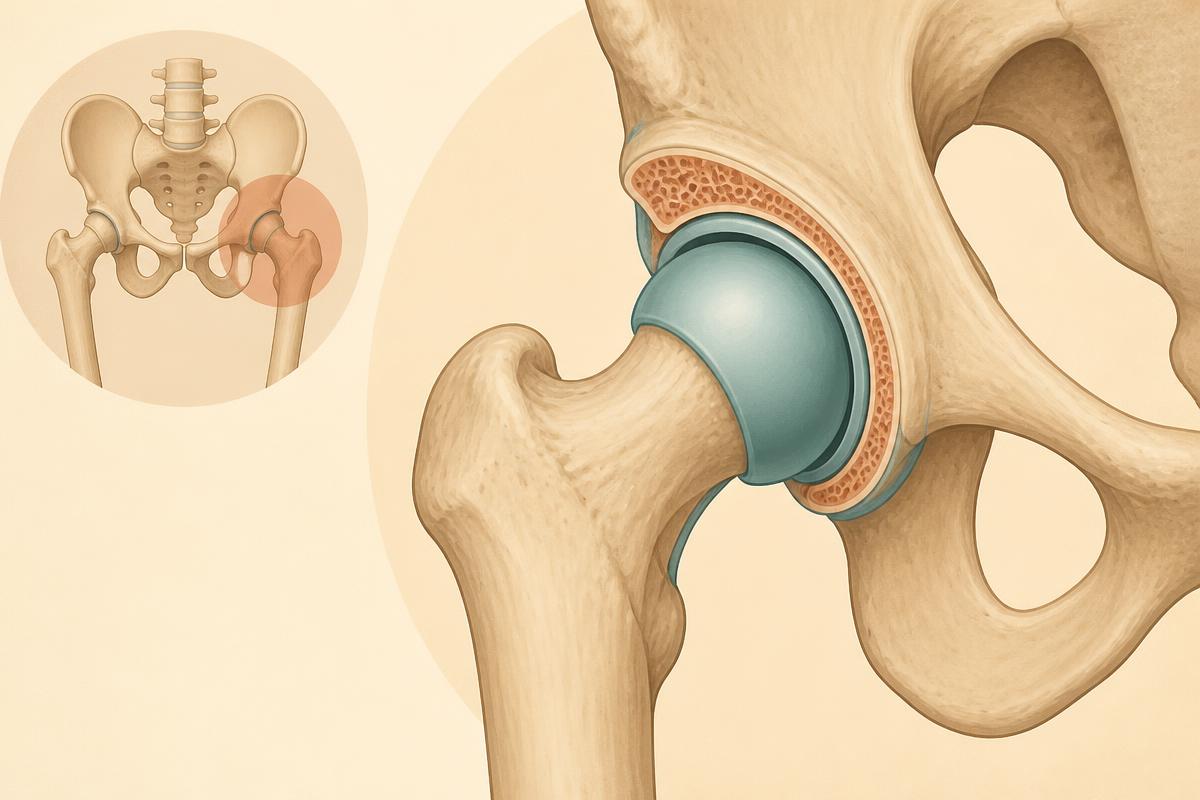
Your hip is a ball-and-socket joint. The rounded top of your thigh bone (the femoral head) sits inside a cup-shaped socket in your pelvis (the acetabulum). Both surfaces are covered in smooth, slippery cartilage and bathed in a small amount of joint fluid, so they glide against each other almost without friction.
A tough sleeve called the joint capsule wraps around the whole joint, reinforced by strong ligaments — the largest of which, the iliofemoral ligament, is one of the strongest in the body. This design is a clever compromise: it allows a wide range of movement in every direction while carrying several times your body weight each time you stand, walk or climb stairs.
The muscles that move it
Movement comes from the muscles that cross the joint. Two are worth knowing by name, because your physiotherapist will talk about them:
- Gluteus medius — on the side of your hip. It holds your pelvis level when you stand on one leg. When it is weak, your walking develops a characteristic dip or waddle.
- Iliopsoas — deep at the front. It lifts your knee towards your chest, which is how you get into a car or step onto a bus.
These muscles are stretched and moved aside during surgery but not removed. They will feel weak and tired for several weeks, which is completely normal — and is exactly what your exercise programme is designed to fix.
What has gone wrong
By far the most common reason for a hip replacement is osteoarthritis. The cartilage lining thins and roughens until, in places, it disappears entirely and bare bone grinds on bare bone. The bone reacts by thickening and growing small spurs, the capsule becomes inflamed and tight, and the joint gradually stiffens.
Other reasons people need the same operation include:
- Rheumatoid arthritis or other inflammatory joint disease.
- Avascular necrosis, where the blood supply to the femoral head fails and the bone collapses.
- A previous fracture of the hip, or a hip that did not form normally in childhood.
What this feels like day to day
People who reach the point of surgery usually describe a very consistent picture: deep pain in the groin or buttock that sometimes travels to the knee, pain that no longer settles with rest, disturbed sleep, and increasing difficulty with the ordinary business of life — putting on socks and shoes, getting out of a low chair, walking to the shops, climbing stairs.
Your team may ask you to complete a questionnaire called the Oxford Hip Score. It asks twelve questions about pain and daily activities and turns your answers into a number. This is not a test you can pass or fail. It records how much the hip is affecting your life, helps decide whether surgery is the right step, and gives a baseline to compare against afterwards so you can see your own improvement.
Surgery is not the first step
National guidance is clear that non-surgical treatment should be tried first: pain relief, physiotherapy, weight management, walking aids and sometimes steroid injections. A hip replacement is offered when those measures no longer control your symptoms and the hip is genuinely limiting your life. If you feel you were rushed towards surgery — or that you have waited too long — say so at your next appointment.
What the operation replaces
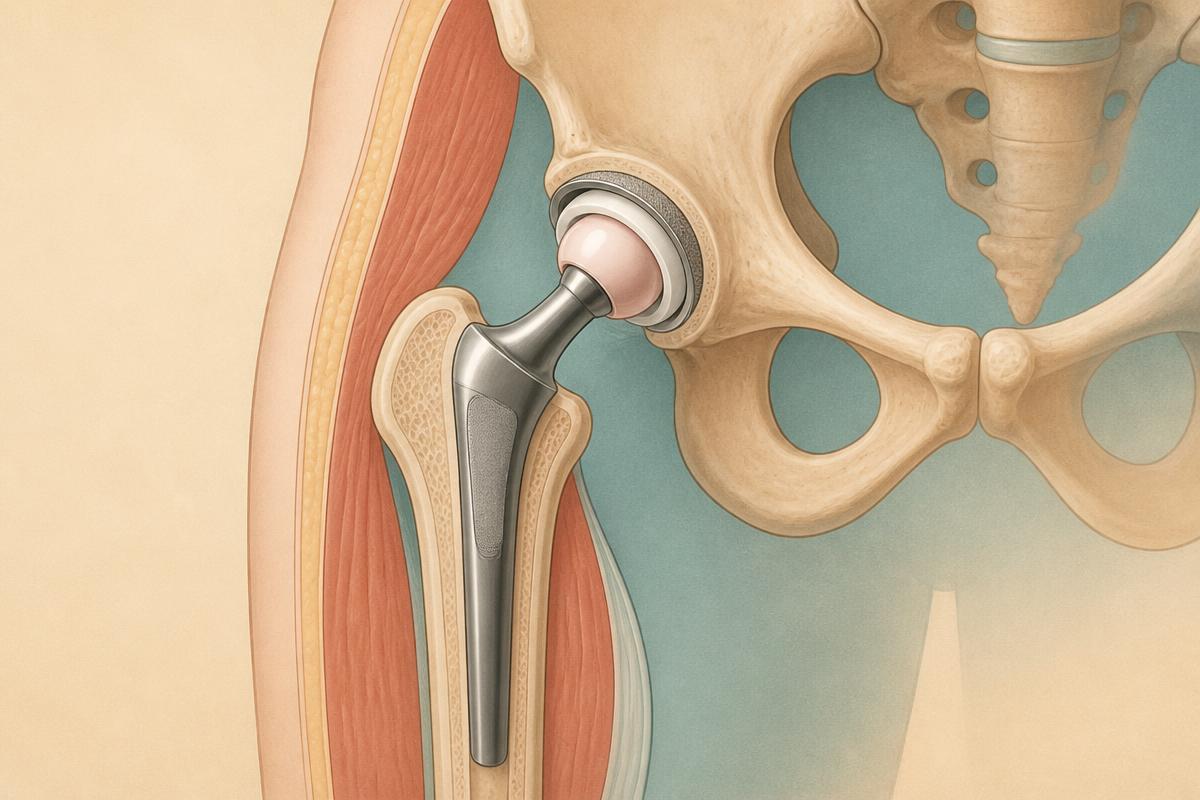
A total hip replacement (also called a total hip arthroplasty) replaces both worn surfaces:
- The damaged ball at the top of your thigh bone is removed and replaced by a smooth new head — usually ceramic or metal — mounted on a stem that sits down inside the hollow centre of the thigh bone.
- The worn socket is reshaped and lined with a cup, normally a metal shell with a hard-wearing plastic (polyethylene) or ceramic liner inside it.
The new ball rolls inside the new liner, restoring the smooth, low-friction movement your own cartilage used to provide.
Cemented, uncemented or hybrid
The parts have to be held firmly in place, and there are three accepted ways of doing it. Your surgeon chooses based on your age, the strength of your bone and their own experience.
- Cemented — a fast-setting bone cement fixes the parts immediately. This is often preferred in older patients and in softer, more osteoporotic bone, because it gives instant stability and allows full weight-bearing straight away. The cement can also carry antibiotic, which helps reduce the risk of infection.
- Uncemented — the implants have a specially textured surface that your own bone grows into over the following weeks. This is often favoured in younger patients with strong bone, where very long-term durability matters most.
- Hybrid — a combination: typically a cemented stem with an uncemented cup.
Every implant used in the NHS is rated by an independent panel and tracked in the National Joint Registry, which follows how long implants last across the whole country. Around 90% are still functioning well at 15 years. You are welcome to ask which implant your surgeon plans to use and why.
Will it be done with a robot?
Some hospitals use computer-assisted or robotic systems to help position the components very precisely. These are impressive tools, and they do improve the accuracy of placement. However, the current evidence has not yet shown that they consistently produce better long-term results or fewer revision operations than a well-performed conventional operation. If your hospital does not use one, that is not a sign of poorer care.
Next section
Next: Before your surgery